The Medieval World: Islam, Europe and China
In the early 7th century, the Prophet Muhammad began preaching a new monotheistic faith in Mecca, in the Arabian Peninsula. The revelations he received, collected in the Quran, shaped the language, law, morality, and identity of the early Muslim community. Within a century of his death in 632 CE, Islam had spread from Spain to Central Asia, and its cities, Baghdad, Damascus, Cairo, and Córdoba, became centers of science, medicine, mathematics, and philosophy during the Islamic Golden Age (8th–13th century).
Islamic scholars also preserved and expanded Greek learning. In Baghdad’s House of Wisdom, the works of Aristotle and Plato were translated into Arabic, and thinkers such as Avicenna (Ibn Sina) and Averroes (Ibn Rushd) wrote influential commentaries. When these reached Europe in Latin translation, they transformed medieval thought; Dante honors Avicenna and Averroes among the great minds in his Divine Comedy.
In the 14th century, the North African scholar Ibn Khaldun wrote the Muqaddimah (1377), the “introduction” to his universal history. It offers a theory of how societies and dynasties rise and fall: groups bound by strong solidarity (asabiyyah) seize power, grow comfortable with wealth and luxury, and decline within a few generations. It is widely considered a foundational text of sociology, historiography, and economics.
You could start here:
The Quran, 7th century
The Muqaddimah, 1377 CE, Ibn Khaldun
The Divine Comedy, 1321 CE, Dante Alighieri
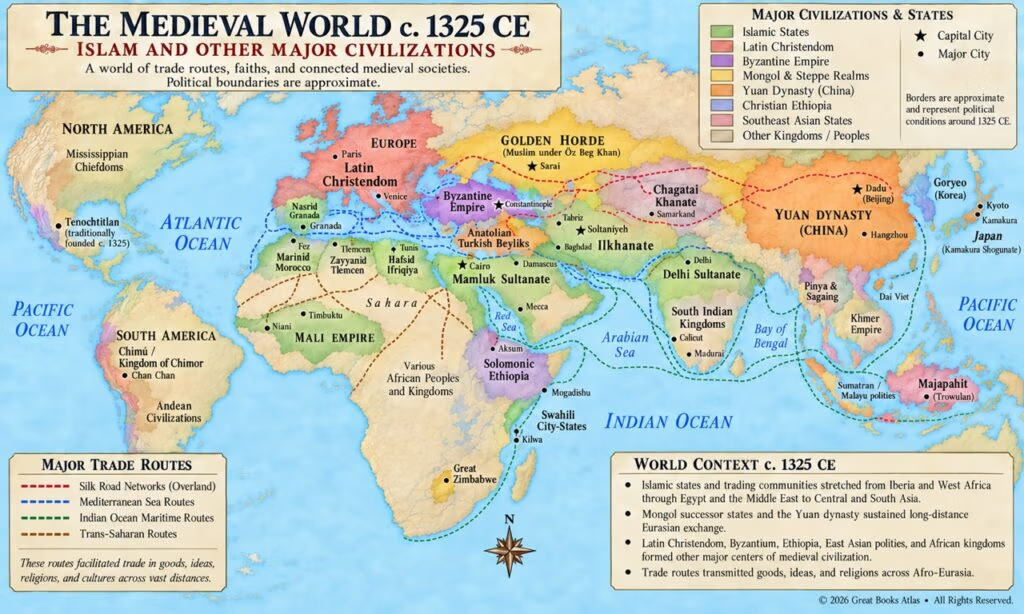
[This map was created with AI tools and is not to scale. Proportions and locations have been simplified or adjusted so all key information fits.]
… more books:
compiled c. 8th–14th century, Persia, Iraq, Syria and Egypt
Summary: To stop King Shahryar, who marries a new bride each night and executes her at dawn, the clever Scheherazade tells him a story each night, always stopping at the most exciting moment. After a thousand and one nights, the king has fallen in love and spares her. Her tales, gathered from Persian, Indian, and Arab sources, include stories of Baghdad’s caliph Harun al-Rashid and the voyages of Sinbad the Sailor. Some of the most famous, such as Aladdin and Ali Baba, were added only in the early 1700s by the French translator Antoine Galland, and the collection became one of the world’s most beloved.
Themes: Love, Justice, and Power
by Jalal al-Din Rumi, c. 1258–1273, Anatolia (Konya), written in Persian
Summary: Often called “the Quran in Persian,” Rumi’s vast mystical poem of over 25,000 verses uses stories, fables, and parables to teach the Sufi path of love toward God. It opens with the song of a reed flute, mourning its separation from the reed bed, an image of the soul longing to return to its divine origin.
Themes: Love, Faith & Spirituality, and Life
by Juan Ruiz, 1330 and 1343, Spain
Summary: Written by Juan Ruiz, the Archpriest of Hita, this masterpiece of medieval Spanish poetry is a playful mock-autobiography in which the narrator recounts his mostly failed love affairs, helped by the cunning go-between Trotaconventos. Ribald comedy alternates with hymns to the Virgin Mary, moral fables, and the comic battle between Sir Carnival and Lady Lent. The title itself is a riddle: is “good love” the love of God or earthly love? Ruiz leaves readers to decide. Written in a Spain where Christians, Muslims, and Jews lived side by side, the book reflects Arabic and Jewish literary influences as well as Christian ones.
Themes: Love, Faith & Spirituality, and Happiness
by Giovanni Boccaccio, c. 1349–1353, Italy
Summary: As the Black Death ravages Florence in 1348, seven young women and three young men flee to a villa in the countryside. To pass the time, each tells one story a day for ten days, making 100 stories in all. Witty, humane, and often bawdy, the tales range from clever tricks and romantic adventures to satire of greedy clergy, celebrating human intelligence and the pleasures of life in the shadow of death. Written in Italian rather than Latin, it laid the foundation for the European short story and inspired Chaucer and Shakespeare. Its frame of stories within a story recalls the One Thousand and One Nights.
Themes: Love, Suffering & Mortality, and Happiness
The Romance of the Three Kingdoms
by Luo Guanzhong, 14th century, China
Summary: One of the Four Great Classical Novels of Chinese literature, this vast historical epic of 120 chapters dramatizes the collapse of the Han dynasty and the century of war that followed (c. 169–280 CE). Three sworn brothers, Liu Bei, Guan Yu, and Zhang Fei, pledge loyalty in the famous Oath of the Peach Garden, facing the cunning warlord Cao Cao, while the strategist Zhuge Liang becomes the model of wisdom in war. Its opening line echoes Ibn Khaldun’s theory of rise and decline: “The empire, long divided, must unite; long united, must divide.”
Themes: War, Leadership, Power, and Duty
by Geoffrey Chaucer, c. 1387–1400, England
Summary: Some thirty pilgrims, from a knight and a nun to a miller and the much-married Wife of Bath, set out from a London inn to the shrine of Thomas Becket at Canterbury Cathedral. To pass the time, they hold a storytelling contest, and their tales, from noble romances to crude jokes and sermons, form a vivid portrait of English society. Written in Middle English when most serious literature was in Latin or French, it helped establish English as a literary language. Chaucer died before finishing it: only 24 of the planned 120 tales were completed.
Themes: Love, Faith & Spirituality, and Justice
even more Books…
To our Timelines
To our Maps