Rome and Christianity
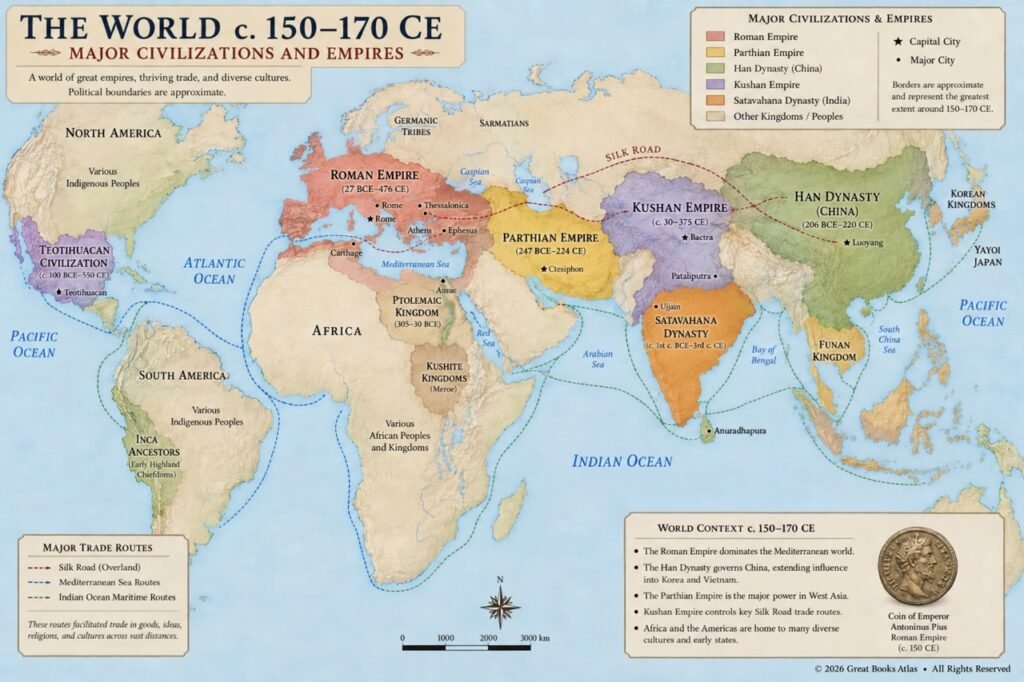
Rome’s territories expanded steadily during the period of the Republic. By the time of the access of the first emperor, Augustus, in 27 BCE, Rome controlled all of the Mediterranean. By 120 CE, the empires’s borders were settled, and it entered the period of the greater stability. Christianity spread across the Roman Empire and some neighboring areas in the first centuries CE. Its adherents were persecuted until the early 4th century, when the religion gained official recognition. In 206 BCE the Rebel leader Liu Bang reunified China and founded the Han Empire. He instated a highly effective centralized government. It lasted until 220 CE. At the height of the Han’s 400-year rule, China was the dominant cultural, political, and economic; force in Asia.
You could start here:
The Aeneid, 29-19 BCE, Virgil
The New Testament, 1st century CE, especially the Gospels
Meditations, c. 170 CE, Marcus Aurelius
…more books:
by Epictetus, c. 108 CE, Rome
Summary: The Discourses of Epictetus are a collection of informal lecture notes and conversations recorded by his student Arrian, outlining the practical everyday ethics of Stoic philosophy. They are referred to and quoted by Marcus Aurelius.
Themes: Freedom, Power, Desires
by Flavius Josephus, c. 75 CE, Roman/Jewish world
Summary: Divided into seven books, it opens with a summary of Jewish history from capture of Jerusalem in 168 BC to the first stages of the First Jewish-Roman War.
Themes: Power, God, Tyranny, Courage, Sacrifice,
by Ovid, 8 CE, Rome
Summary: Is a Latin narrative poem by the Roman poet Ovid. It chronicles the history of the world from its creation to the deification of Julius Cesar in a historical framework comprising over 250 myths, 15 books, and 11,995 lines. The Metamorphoses is one of the most influential works of Western culture.
Themes: Love, Mortality, Power, Transformation
even more Books…
To our Timelines
To our Maps