China, the Hundred Schools of Thought
In the Eastern Zhou period, China was divided into rival states whose rulers faced constant warfare from outside and unrest from within. This crisis turned into a golden age of ideas: for roughly three centuries, thinkers traveled from court to court offering competing answers to one urgent question—how can society be brought back into order? This era of debate became known as the Hundred Schools of Thought. The name refers to the many rival movements of the time, including Confucians, Daoists, Mohists, Legalists, each offering its own vision of a well-ordered society. Confucius was the model of the wandering shì, scholar-gentlemen who traveled between courts offering advice on how to govern. His teachings were collected by his followers after his death in the Analects, which became the foundational text of Confucianism. The Tao Te Ching (“Classic of the Way and Its Power”) is a short book of 81 brief poetic chapters, full of paradoxes such as “the soft overcomes the hard” and “the sage acts by not acting.” Tradition credits it to the sage Laozi, said to have lived in the 6th century BCE as an older contemporary of Confucius. Most scholars today, however, see it as the work of several authors, compiled in the late 4th or early 3rd century BCE. Daoism was further developed by Zhuangzi (Zhuang Zhou), whose book of the same name uses humor, fables and dreamlike stories, most famously his dream of being a butterfly, to question fixed ideas about life, death and the self. It is considered one of the great masterpieces of Chinese literature.
You could start here:
The Analects, 5th – 3rd centuries BCE, Confucius
Tao Te Ching, 4th – 3rd centuries BCE, Laozi, Daoism
Zhuangzi, 4th – 3rd centuries BCE, Zhuang Zhou, Daoism
Below is a map of the spread of Confucianism, Daoism, Mohism, and Legalism during the later Zhou period, 770 to 221 BCE.
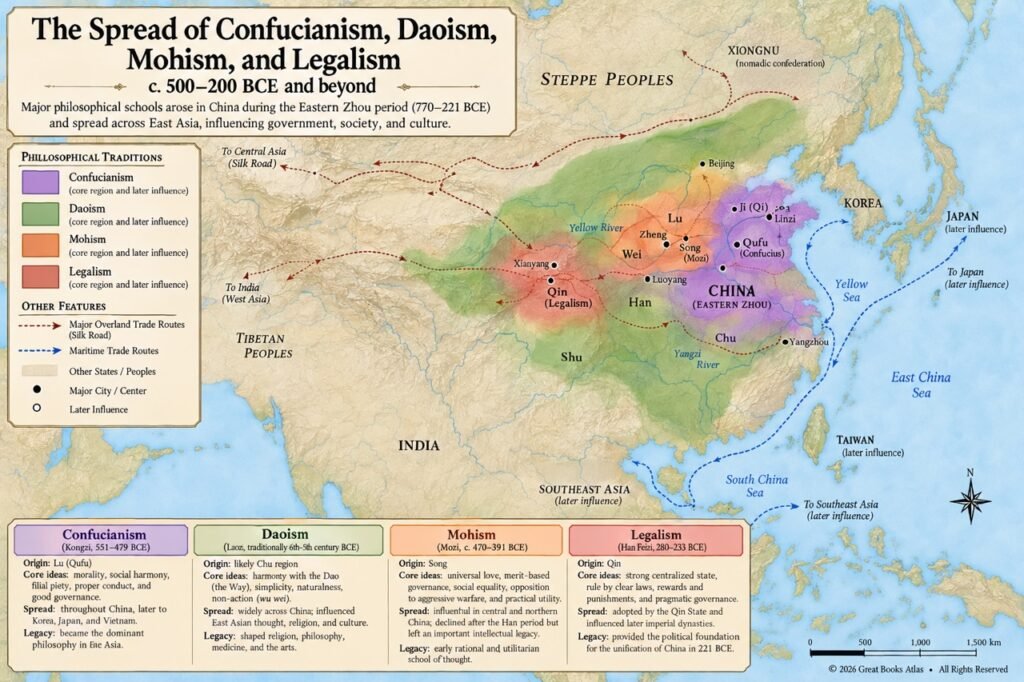
[This map was created with AI tools and is not to scale. Proportions and locations have been simplified or adjusted so all key information fits.]
… more books:
by Sun Tzu, c. 5th century BCE
Summary: The Art of War, traditionally attributed to the general Sun Tzu, teaches that wars are won through preparation, strategy and understanding the enemy rather than raw force. Its most famous idea is that the greatest victory is to defeat the enemy without fighting at all; battle is a costly, risky last resort. It is still read today far beyond the military, in business, politics and sports.
Themes: War, Leadership, and Power
by Mo Di, 5th – 3rd century BCE
Summary: The Mozi collects the teachings of Mo Di (c. 470–391 BCE), founder of Mohism, as recorded and expanded by his followers. Mohism challenged Confucianism head-on: instead of love graded by family ties, it called for “impartial caring” for all people, condemned offensive war, and judged every custom by a simple test: does it benefit the people? Unlike the brief sayings of the Analects or the poetic chapters of the Tao Te Ching, the Mozi is written in clear, step-by-step arguments designed to persuade rulers. Mohism faded as a school after China’s unification under the Qin, but the text survived and is valued today as one of the earliest works of systematic Chinese philosophy.
Themes: Leadership, Love, and Justice
The Shiji, or Historical Records
by Sima Qian, late 2nd and early 1st centuries BCE
Summary: Sima Qian’s Shiji is the first comprehensive history of China, tracing about 2,500 years from the legendary Yellow Emperor to Emperor Wu of Han, under whom Sima Qian himself served. In 130 chapters, it combines royal chronicles, tables of dates, treatises on topics such as music, astronomy and economics, and vivid biographies of rulers, generals, philosophers and even assassins. Sima Qian completed the work after being punished with castration for defending a disgraced general, choosing humiliation over suicide so that he could finish his history. His format became the model for China’s official dynastic histories for the next two thousand years, and he is still regarded as China’s greatest historian.
Themes: Power, Leadership, Justice, Truth & Knowledge
even more Books…
To our Timelines
To our Maps