Leadership Reading Path
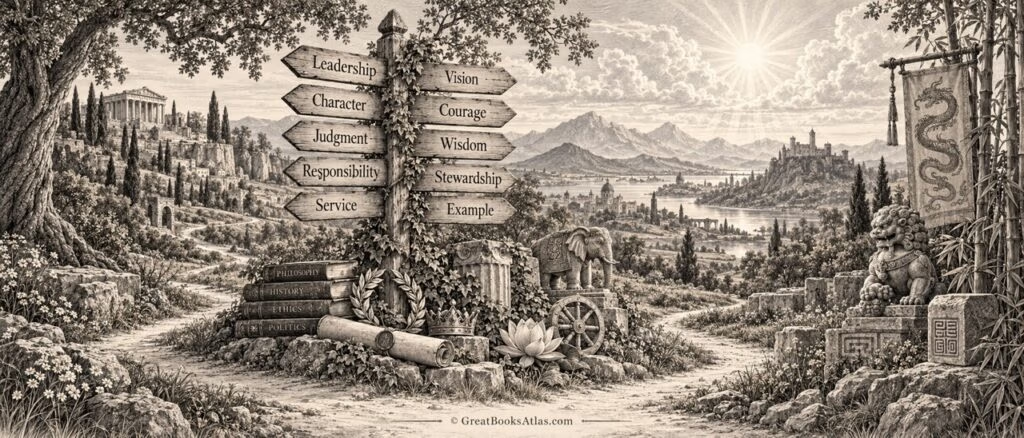
[Image was created with AI tools and is meant only as inspiration.]
What Makes a Good Leader? — The foundational path
Analects → Republic → Nicomachean Ethics → Meditations → Prince
This introduces five major models:
Confucius: Lead through moral example.
Plato: Let wisdom rule.
Aristotle: Develop virtue and practical judgment.
Marcus Aurelius: Master yourself.
Machiavelli: Understand power as it actually works.
Its central question:
Is leadership fundamentally about character—or competence?
Leadership and Power
Republic → Politics → Prince → Leviathan → Two Treatise of Government → Social Contract
This path asks how authority becomes legitimate.
Plato searches for the right ruler; Aristotle asks whose interests rulers serve; Machiavelli studies how power is maintained; Hobbes emphasizes order; Locke limits government through rights; Rousseau roots legitimacy in collective self-government.
The progression is essentially:
Who should rule? → How do rulers rule? → Why should anyone obey them?
Leadership in War
Iliad → Art of War → History of the Peloponnesian War → Henry V → War and Peace
This is a particularly strong sequence.
Homer examines pride and fractured command. Sun Tzu emphasizes intelligence and efficiency; Thucydides studies judgment during political crisis; Shakespeare shows inspiration and rhetoric; Tolstoy finally questions how much commanders actually control.
The guiding question:
How much of victory belongs to the leader—and how much to circumstance?
Leadership as Duty
Bhagavad Gita → Aeneid → Ramayana → Meditations
These works approach leadership from very different civilizations yet converge around responsibility.
Arjuna, Aeneas, Rama, and Marcus all confront the idea that leadership demands subordinating ego and personal comfort to obligations larger than oneself.
Its central question:
What must a leader be willing to sacrifice?
The Failure of Leaders
Iliad → Antigone → King Lear → Macbeth
This would make an excellent compact reading path.
Agamemnon: pride and disrespect.
Creon: rigidity and refusal to listen.
Lear: vanity and inability to distinguish truth from flattery.
Macbeth: ambition and fear.
Together they produce an extraordinary warning:
Leadership failure often begins inside the leader before it becomes visible in the organization or state.
Strategy and Political Realism
Art of War → Arthashastra → Thucydides → Prince → Romance of the Three Kingdoms
This path studies leadership without assuming that virtue alone produces good outcomes.
The works emphasize information, incentives, alliances, deception, fear, reputation, military capacity, timing, and adaptability.
Its uncomfortable but essential question is:
Can someone lead responsibly without understanding how power actually works?
Leadership Through Character
Analects → Nicomachean Ethics → Parallel Lives → Meditations
This is the opposite path.
Instead of institutions and strategy, it asks:
What kind of human being should a leader become?
Confucius emphasizes moral cultivation; Aristotle develops virtue and judgment; Plutarch studies character through historical examples; Marcus turns self-governance into a daily discipline.
Leadership Beyond the Hero
Discourses on Livy → Federalist Papers → Democracy in America → Muqaddimah → War and Peace
This is one of the most sophisticated paths for the Atlas.
It progressively challenges the idea that history is made primarily by exceptional leaders.
Machiavelli studies republican institutions; Madison and Hamilton design checks and balances; Tocquevilleemphasizes civic society; Ibn Khaldun emphasizes social cohesion; Tolstoy questions the entire “great man” explanation of history.
The shared insight is:
Leadership matters—but institutions, culture, social cohesion, and collective action may matter even more.