Essays
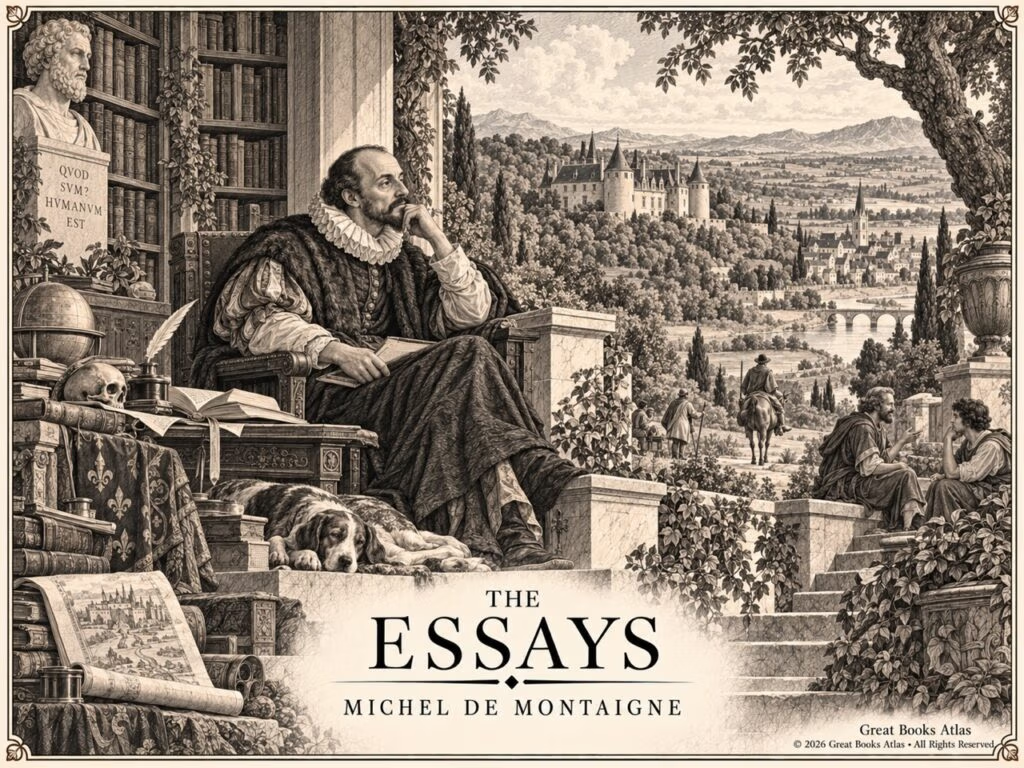
[Images were created with AI tools to set the scene and offer a glimpse of the civilization and themes behind the book. As an avid reader, I hope they spark your curiosity, but nothing replaces reading the book and picturing it for yourself. These images are meant only as inspiration.]
Author:
Time:
First published 1580; expanded 1588.
Civilization:
Connected to:
The Prince, Hamlet, Meditations, Nicomachean Ethics
Themes:
Love, Truth & Knowledge, Mortality, Happiness, Freedom
Summary:
In his Essays, Michel de Montaigne set out to portray himself honestly, “in good faith,” with all his habits, doubts, and contradictions. Writing on everything from friendship and education to cruelty, fear, and death, he tested his judgment against experience and classical authors, and in the process invented the essay as a form. His recurring question, “What do I know?”, makes the book a landmark of skeptical, self-examining thought. He opens modestly, telling readers that he himself is the subject of the book and that they would be foolish to spend their leisure on so slight a subject. Yet by studying one person so closely, he revealed much about human nature in general.
Ingrid’s comment: Machiavelli studies how power works; Montaigne turns the same honest gaze inward and asks: What do I actually know – about myself, and about anything?
Relation to other Books:
The Prince – Both writers are Renaissance realists who describe people as they are, not as they ought to be. Machiavelli turns that realism toward the state. Montaigne turns it toward himself, and he resists the idea that usefulness justifies dishonesty. In his essay “Of the Useful and the Honorable” (Book III), he says plainly that he will not serve a cause through betrayal. Hamlet – Shakespeare’s Hamlet is a doubter. He asks what a human being is and how anyone can act without being certain. That makes him a close relative of Montaigne the skeptic. John Florio’s English translation of the Essays appeared in 1603, and Shakespeare clearly used it later in The Tempest. Many scholars also hear Montaigne in Hamlet, though a direct link there is debated. Nicomachean Ethics – Aristotle calls friendship one of life’s greatest goods. Montaigne’s essay “Of Friendship” picks up that idea and quotes Aristotle in it. The essay is a tribute to his late friend Étienne de La Boétie: “Because it was he, because it was I.” This is also why the Love theme fits the book. Meditations – Marcus Aurelius also wrote private reflections addressed only to himself, and he too returns again and again to death and self-command. Montaigne took his Stoicism mainly from Seneca, and his early essay “To philosophize is to learn to die” carries the same spirit. Over time, though, he moved from Stoic discipline toward an easier acceptance of human weakness.
Wikipedia:
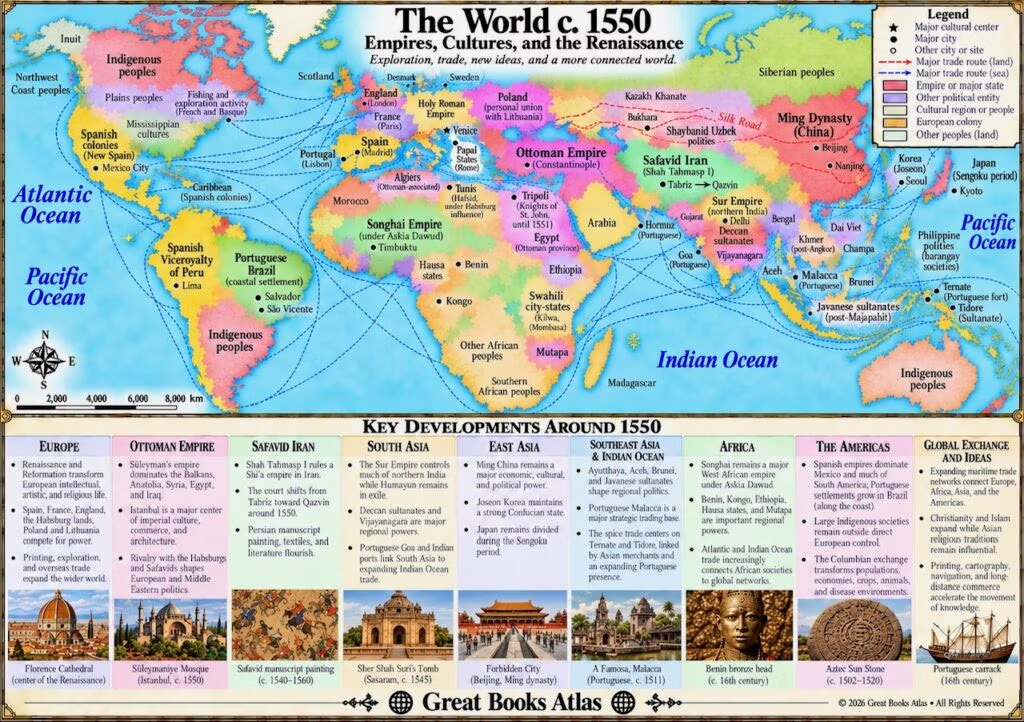
[This map was created with AI tools and is not to scale. Proportions and locations have been simplified or adjusted so all key information fits.]