Duty Reading Paths
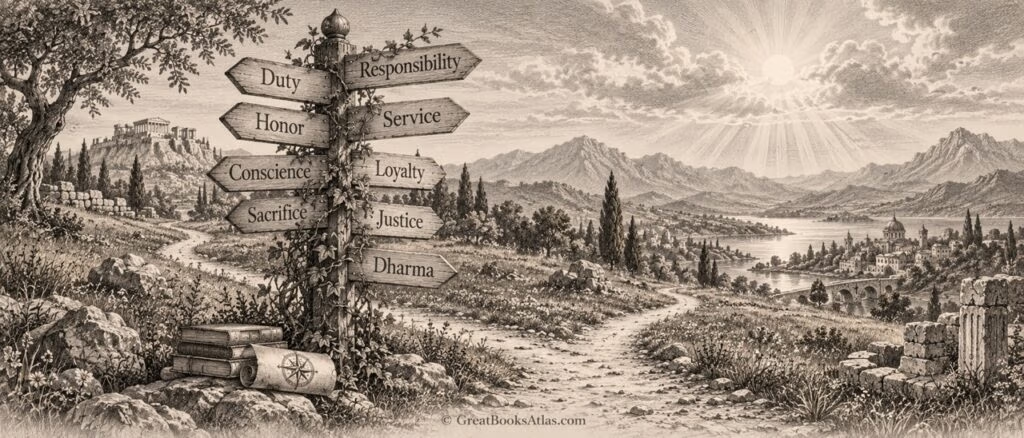
[Image was created with AI tools and is meant only as inspiration.]
What Is Duty? — The foundational path
Bhagavad Gita → Analects → Nicomachean Ethics → Meditations → Groundwork of the Metaphysics of Morals
This gives readers five major answers:
Gita: Fulfill your dharma.
Confucius: Fulfill your relationships well.
Aristotle: Become virtuous.
Marcus: Perform your rational and social role.
Kant: Follow universal moral principles.
Its guiding question:
Does duty come from the role we occupy, the person we become, or a moral law that applies equally to everyone?
Duty versus Love
Ramayana → Aeneid → Odyssey → King Lear → Works of Love
This path explores situations in which love and obligation reinforce one another—and situations in which they painfully collide.
The Ramayana and Aeneid show public duty overriding personal love; the Odyssey celebrates fidelity; King Lear distinguishes genuine loyalty from performative affection; Kierkegaard finally asks whether love itself can become a duty.
Duty versus Conscience
Antigone → Apology → Crito → Civil Disobedience
This is perhaps the clearest political duty sequence.
Antigone: Disobey an unjust command.
Socrates in Apology: Never abandon moral principle merely to survive.
Socrates in Crito: Political membership creates genuine obligations.
Thoreau: Yet those obligations end where participation in serious injustice begins.
The central question:
When must a good citizen refuse to obey?
Duty and Leadership
Aeneid → Analects → Politics → Prince → Meditations → Henry V
This path asks what people with power owe those they lead.
Confucius and Aristotle stress moral character and the common good; Machiavelli asks what happens when political survival conflicts with ordinary morality; Marcus turns imperial responsibility inward toward self-command; Shakespeare examines how rulers persuade others to sacrifice for collective purposes.
Its guiding question:
Does authority give a person privileges—or greater obligations?
Duty in War
Iliad → Bhagavad Gita → Aeneid → Tale of the Heike → Henry V
These works ask what soldiers and leaders owe to comrades, rulers, families, political communities, and enemies.
They also reveal an important evolution:
Is courage simply fulfilling martial duty—or must the duty to fight itself first be morally justified?
Arjuna makes that question explicit; Shakespeare later transfers much of the responsibility from the warrior to the leader who orders the war.
Duty, Freedom and the State
Crito → Two Treatises of Government → Social Contract → Federalist Papers → Civil Disobedience
This path traces the transformation of political obligation.
Socrates asks why citizens should obey law. Locke says governments themselves have duties toward natural rights; Rousseau tries to reconcile obedience with self-government; Madison and Hamilton build duty into institutions; Thoreau reasserts the individual’s moral responsibility when institutions fail.
The guiding question is:
What do citizens owe government—and what does government owe citizens?
Duty as Spiritual Practice
Book of Job → Bhagavad Gita → Confessions → Imitation of Christ → Divine Comedy
This path moves duty beyond social rules into the relationship between human action and ultimate reality.
Job asks whether faithfulness survives suffering; the Gita turns ordinary action into spiritual discipline; Augustine examines the divided will; Thomas à Kempis makes service and humility forms of imitation; Dante depicts freedom and responsibility within an eternally meaningful moral order.
From Duty to Responsibility for Others
Analects → Nicomachean Ethics → Brothers Karamazov → Works of Love
This path shifts from prescribed obligation toward a broader conception of moral responsibility.
Confucius begins with concrete relationships; Aristotle connects friendship and virtue; Dostoevsky expands responsibility toward every human being; Kierkegaard asks us to love even the neighbor we did not choose.
Its deepest question is:
How far does my responsibility for another person extend?