Ancient Foundations
City-based civilizations are thought to have originated in Mesopotamia, followed by Egypt’s Nile Valley. Civilizations grew independently in the fertile basin of the Yellow River in China and the Indus Valley in today’s Pakistan and India. In each case, a great river created the conditions for intensive, efficient agriculture. Early cities also grew in Peru, for reasons not yet fully understood. In Europe, the Minoans built highly developed urban settlements entered around grand palaces.
You could start here:
The Epic of Gilgamesh, c. 1200 BCE (Standard Babylonian version), Sumerian poems as early as 2100 BCE, Mesopotamia
The Hebrew Bible, c. 1000-2nd century BCE, Ancient Levant
The Iliad, c. 750 BCE, Greece
The Odyssey, c. 700 BCE, Greece
(thought The Iliad and The Odyssey were written around 750-700 BCE, they describe Greece around the Trojan War, c. 12th century BCE)
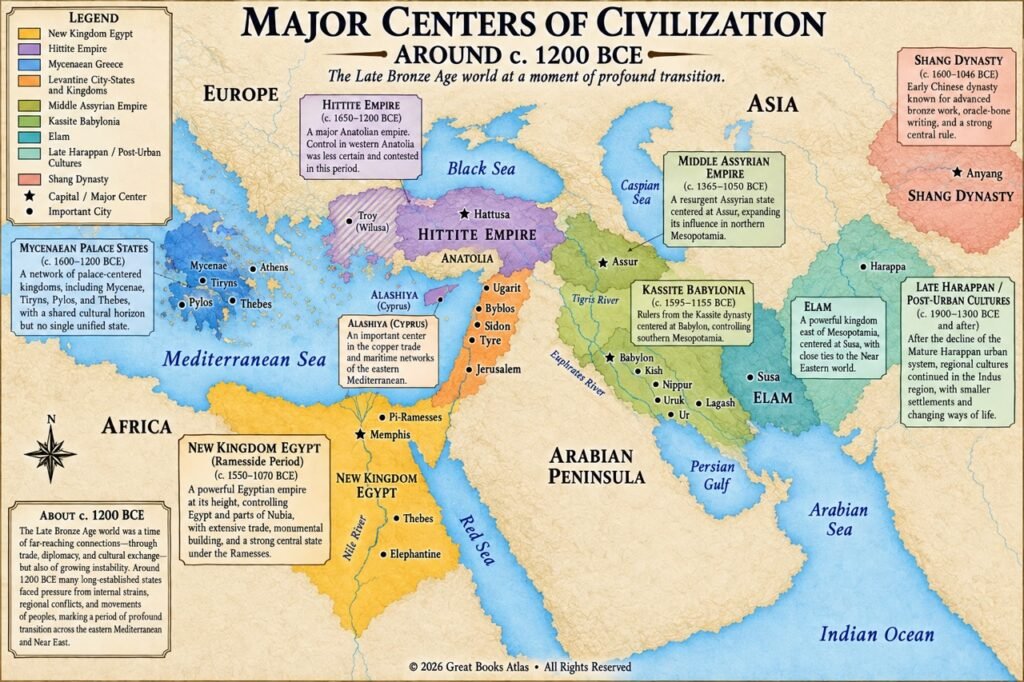
[This map was created with AI tools and is not to scale. Proportions and locations have been simplified or adjusted so all key information fits.]
…more books:
Ecclesiastes
traditionally attributed to King Solomon, date uncertain (often placed 5th-3rd century BCE), Ancient Levant
Summary: Qoheleth (the ‘Teacher’) examines wealth, pleasure, wisdom, work, achievement, and human ambition and repeatedly confronts their transience in the face of death. Rather than offering a simple answer to life’s meaning, the work urges humans to recognize their limitations and appreciate the ordinary gifts of life while they can. Modern scholarship generally dates it much later than the reign of Solomon, probably to the fourth or third century BCE.
Themes: Meaning of Life, Mortality, Happiness, Truth & Knowledge, Faith & Spirituality, Justice, Power, Duty, and Leadership
Song of Songs
traditionally attributed to King Solomon, 4th to 3rd century BCE, Ancient Levant
Summary: The Song of Songs is a biblical poem. Unlike other books in the Hebrew Bible, it is erotic poetry; lovers express passionate desire, exchange compliments, and invite one another to enjoy. Its authorship, date and origins remain uncertain, with scholars debating its unity, structure, and possible influences from Mesopotamian, Egyptian, and Greek love poetry.
Themes: Love, Happiness, Mortality, Leadership, and Faith & Spirituality
even more Books…
To our Timelines
To our Maps