225 CE - Growing Religious Diversity
Silk Road corridors and maritime routes connect Rome, Iran, India, Central Asia, and China. Buddhism spreads through Central and East Asia; Christianity grows within the Roman world.
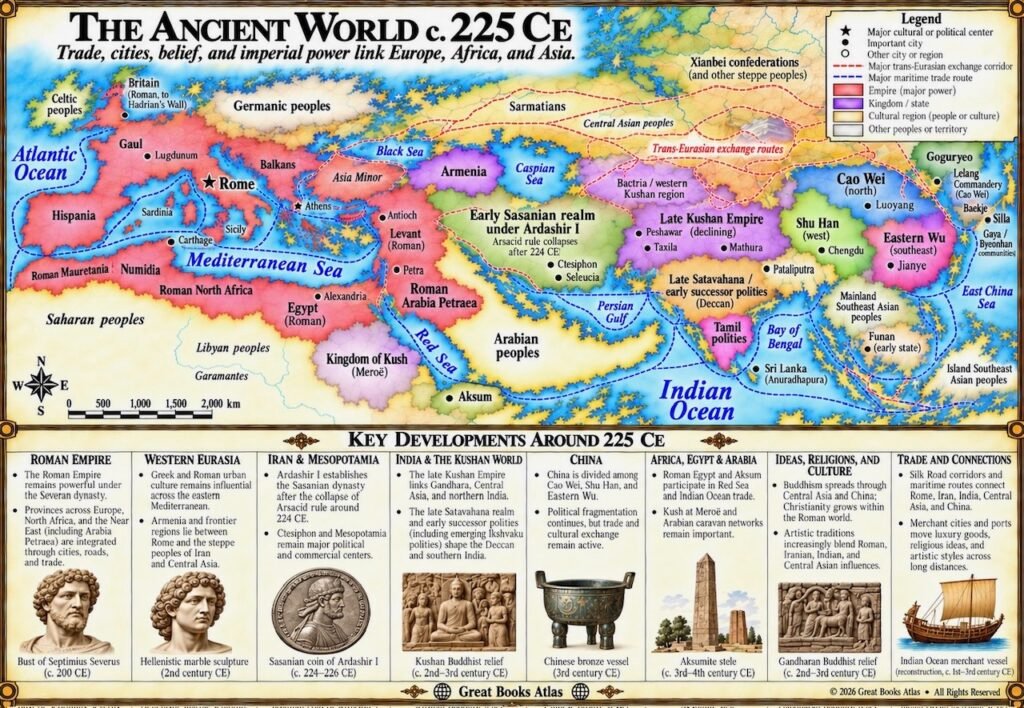
[This map was created with AI tools and is not to scale. Proportions and locations have been simplified or adjusted so all key information fits.]
Map highlights: The Roman Empire remains powerful under the Severan dynasty. – Provinces across Europe. North Africa, and the Near East are integrated through cities, roads, and trade. – Greek and Roman urban culture remains influential across the eastern Mediterranean. – Armenia and frontier regions lie between Rome and the steppe peoples of Iran and Central Asia. – Ardashir I establishes the Sasanian dynasty after the collapse of Arsacid rule around 224 CE. – Ctesiphon and Mesopotamia remain major political and commercial centers. – The late Kushan Empire links Gandhara, Central Asia, and northern India. – The late Satavahana realm and early successor polities shape the Decan and southern India. – China is divided among Cao Wei, Shu Han, and Eastern Wu. – Roman Egypt and Aksum participate in Red Sea and Indian Ocean trade. – Kush at Meroë and Arabian caravan networks remain important. – Buddhism spreads through Central Asia and China; Christianity grows within the Roman world. – Artistic traditions increasingly blend Roman, Iranian, Indian, and Central Asian influences. – Silk Road corridors and maritime routes connect Rome, Iran, India, Central Asia, and China. – Merchant cities and ports move luxury goods, religious ideas, and artistic styles across long distances.
Back to our Maps