100 BCE - Roman Republic in Crisis
Several pivotal texts, religious codices, and foundational compilations were written or finalized right around this time: The Book of Enoch, The Dead Sea Scrolls, The Hebrew Bible Canon, The Bibliotheca (The Library of Greek Mythology), Early Sangam Literature, Buddhist Pali Canon
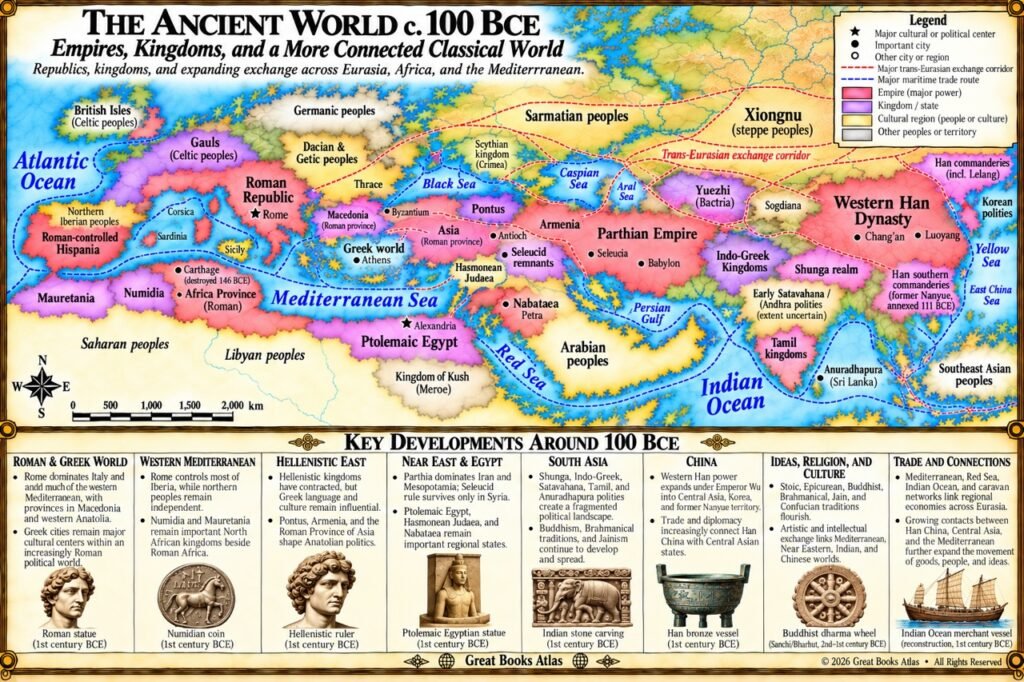
[This map was created with AI tools and is not to scale. Proportions and locations have been simplified or adjusted so all key information fits.]
Map highlights: Rome dominates Italy and much of the western Mediterranean, with provinces in Macedonia and western Anatolia. – Greek cities remain major cultural centers within an increasingly Roman political world. – Rome controls most of Iberia, while northern peoples remain independent. – Numidia and Mauretania remain important North African kingdoms beside Roman Africa. – Hellenistic kingdoms have contracted, but Greek language and culture remain influential. – Pontus, Armenia, and the Roman Province of Asia shape Anatolian politics. – Parthia dominates Iran and Mesopotamia; Seleucid rule survives only in Syria. – Ptolemaic Egypt, Hasmonean Judea, and Nabataean remain important regional states. – Shunga, Indo-Greek, Satvahana, Tamil, and Anuradhapura polities create a fragmented political landscape. Buddhism, Brahmanical traditions, and Jainism continue to develop and spread. – Western Han power expands under Emperor Wu into Central Asia, Korea, and former Nanyue territory. – Trade and diplomacy increasingly connect Han China with Central Asian states. – Stoic, Epicurean, Buddhist, Brahmanical, Jain, and Confucian traditions flourish. – Artistic and intellectual exchange links Mediterranean, Near Eastern, Indian, and Chinese worlds. – Mediterranean, Red Sea, Indian Ocean, and caravan networks link regional economies across Eurasia. – Growing contact between Han China, Central Asia, and the Mediterranean further expand the movement of goods, people, and ideas.
Back to our Maps