500 BCE - The Classical and Axial World
Confucius and other teacher are active in China. Greek thinkers investigate nature, ethics, and politics. Buddhist and Jain traditions develop in northern India.
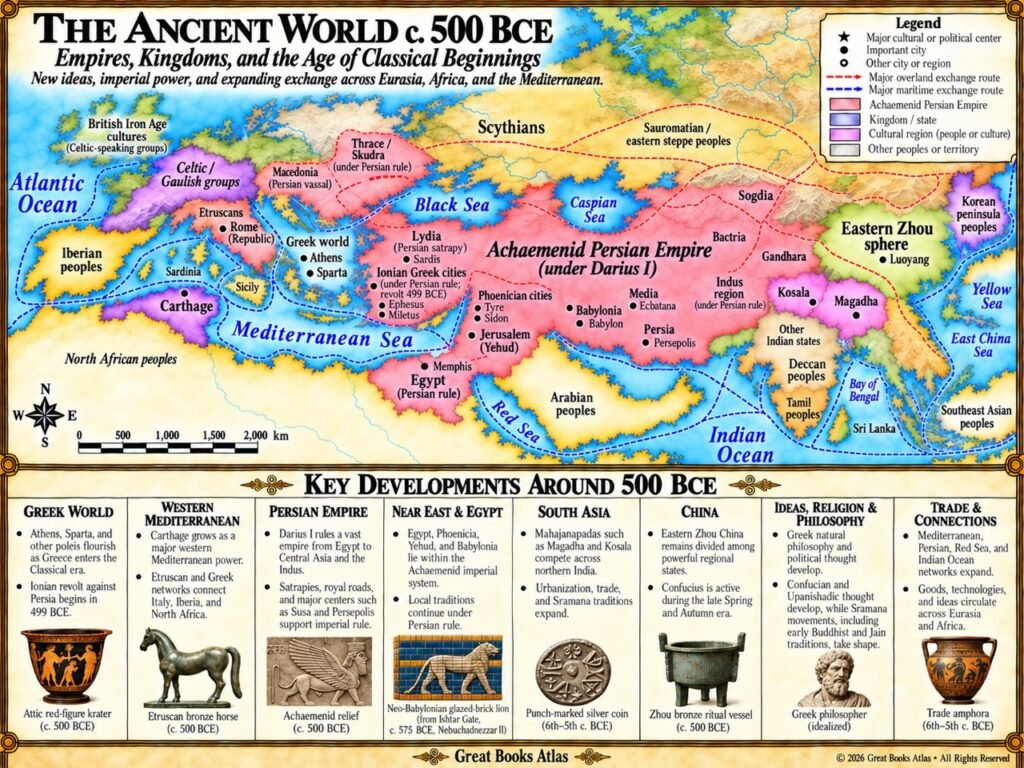
(Map is approximate and for illustration purpose only.)
Maps highlights: Athens, Sparta, and other poleis flourish as Greece enters the Classical era – Ionian revolt against Persia begins in 499 BCE – Carthage grows as a major western Mediterranean power – Darius I rules a vast empire from Egypt to Central Asia and the Indus – Egypt, Phonicia, Yehud, and Babylonia lie within the Achaemenid imperial system – Eastern Zhou China remains divided among powerful regional states – Confucius is active during the late Spring and Autumn era – Confucian and Upanishadic thought develop, while Sramana movements, including early Buddhist and Jain traditions, take shape – Goods, technologies, and ideas circulate across Eurasia and Africa
Back to our Maps