Enlightenment, rights and the modern world
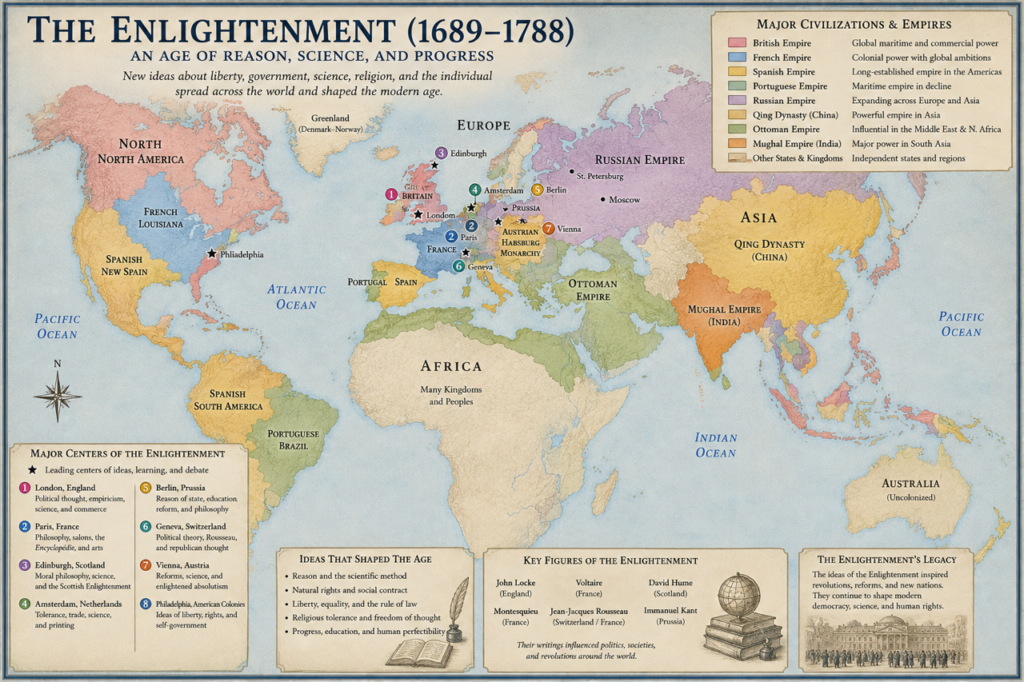
Spanning the mid 17th to the early 19th centuries, the Enlightenment was a European intellectual movement that prioritized reason, science, and individual rights over traditional religious and political authority. In Germany it took the shape of a philosophical and literary movement, known as the Aufklärung. In England, the Enlightenment included thinkers such as John Locke and Thomas Paine, who in turn influenced poets. In France, the movement was associated with philosophies like Jean-Jacques Rousseau or René Descartes. “Rationalist hot spots” ranged from Stockholm to Lisbon, and from Dublin to St. Petersburg.
You could start here:
Two Treatise of Government, 1689, John Locke
The Social Contract, 1762, Jean-Jacques Rousseau
The Federalist Papers, 1787 – 1788, Hamilton, Madison & Jay
On Liberty, 1859, John Stuart Mill
… more books:
by Adam Smith, 1776
Summary: The Wealth of Nations established foundational principles of modern economics, advocating for free markets and the “invisible hand”.
Themes: Labor, Wealth, Invisible Hand, Markets, Government
by René Descartes, 1637
Summary: Pioneered philosophical rationalism and systematic doubt with his premise, “I thin therefore I am”.
Themes: Human Nature, Skepticism, The Four Rules, Truth, Morality
by Immanuel Kant, 1781
Summary: Examined the limits and capabilities of human reason, bridging empiricism and rationalism.
by Voltaire, 1759
Summary: Used biting satire to mock philosophical optimism and religious fanaticism, championing practical work and tolerance instead.
by Jonathan Swift, 1726
Summary: Employed fantastical voyages to critique European politics, human nature, and institutional corruption.
even more Books…
To our Timelines
To our Maps