Greece, Classical Athens and the Academy
In the 5th and 4th centuries BCE, Athens became the birthplace of Western philosophy. Socrates questioned his fellow citizens in the marketplace about justice, courage and the good life, and was executed for it in 399 BCE. His student Plato founded the Academy, the first school of philosophy in the West, where Aristotle studied for twenty years before founding his own school, the Lyceum. Together, these three thinkers shaped nearly every field of philosophy, from ethics and politics to logic and metaphysics. Remarkably, all of Plato’s works are believed to have survived, about 2,400 years later. Alongside them, Herodotus and Thucydides invented history as a form of inquiry, asking not only what happened but why.
You could start here:
The Republic, c. 375 BCE, Plato
Nicomachean Ethics, c. 350 BCE, Aristotle
Politics, c. 350 BCE, Aristotle
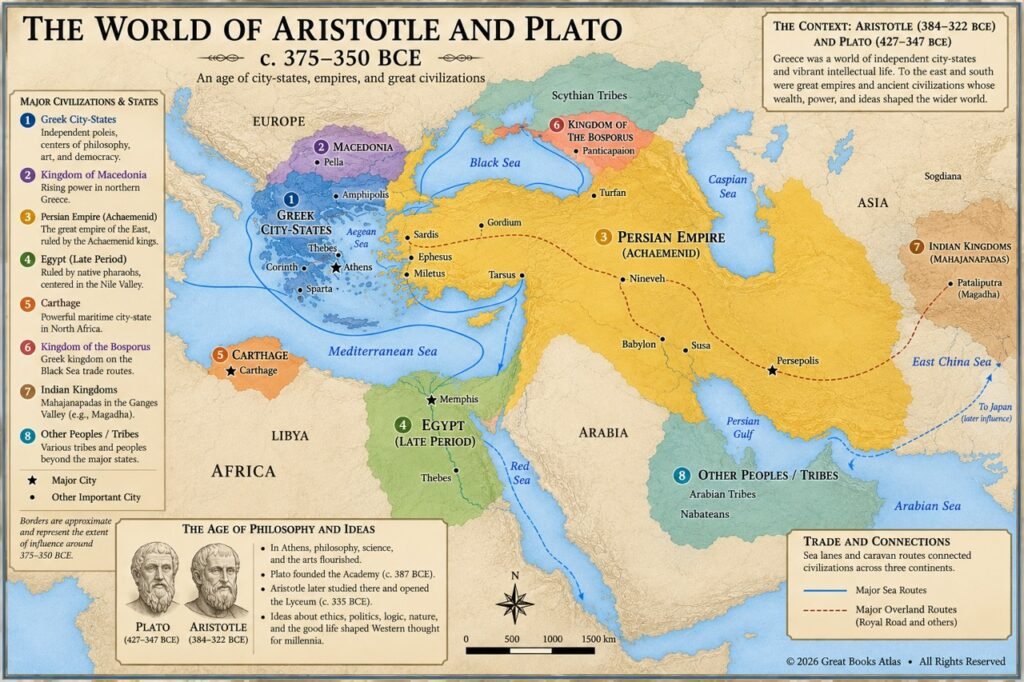
Below is a map of the world in the time of Plato (427 to 347 BCE) and Aristotle (384 to 322 BCE).
… more books:
by Plato, c. 399-387 BCE, Ancient Greece
Summary: Plato presents Socrates’ defense at his trial for impiety and corrupting the young. Socrates argues that living virtuously and examining one’s life matter more than reputation, wealth, or even survival.
Themes: Truth & Knowledge, Justice, Mortality, and Duty
by Herodotus, c. 440 BCE
Summary: The Histories is a pioneering prose work recording the origins and events of the Greco-Persian Wars, framed by an expansive exploration of geography, culture, and lore of the ancient world.
Themes: Hubris, Justice, Freedom, Human Life
The History of the Peloponnesian War
by Thucydides, late 5th century BCE
Summary: The History of the Peloponnesian War is an account of the 27-year conflict (431-404 BCE) between Athens, leader of the Delian League, and Sparta, leader of the Peloponnesian League. The account breaks off in 411 BCE, leaving the work unfinished.
Themes: Power, War, Hubris, Leadership
by Plato, c. 385-370 BCE, Ancient Greece
Summary: At a banquet, Socrates and other guests give competing speeches about the nature of eros, or love. Socrates recounts Diotima’s teaching that love can rise from attraction to an individual body toward love of wisdom, goodness, and ultimately Beauty itself.
Themes: Love, Desire, Beauty, Wisdom, Meaning of Life, Virtue, Immortality, Philosophy
even more Books…
To our Timelines
To our Maps