Zhuangzi
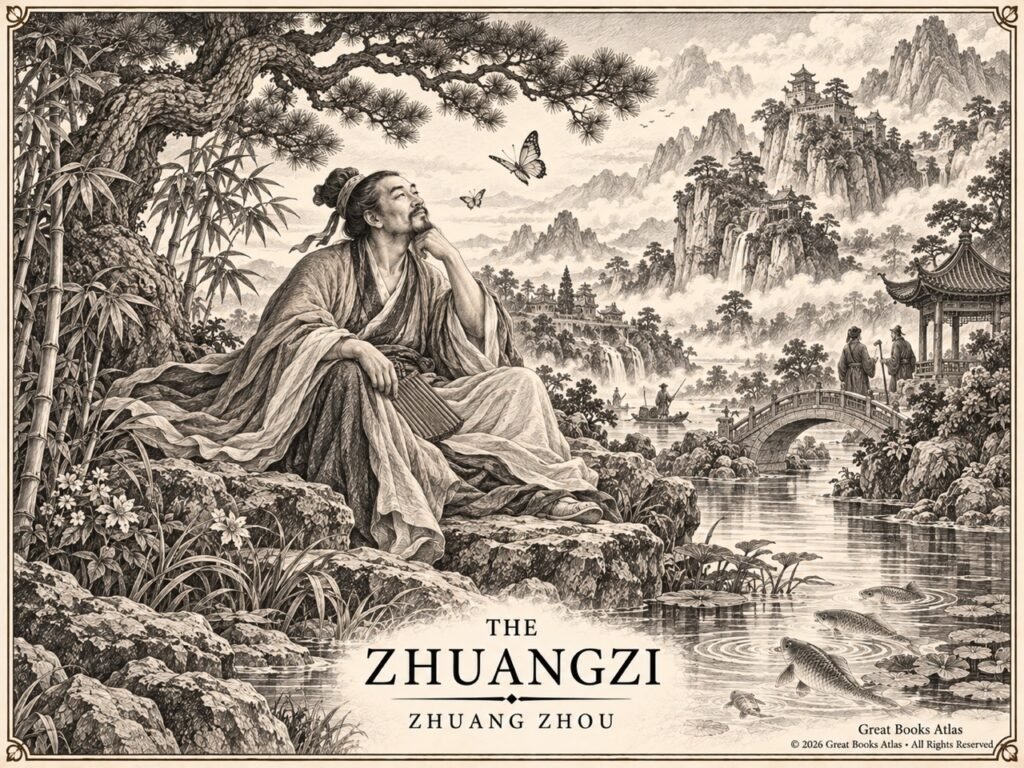
[Images were created with AI tools to set the scene and offer a glimpse of the civilization and themes behind the book. As an avid reader, I hope they spark your curiosity, but nothing replaces reading the book and picturing it for yourself. These images are meant only as inspiration.]
Author:
Zhuang Zhou (c. 369–286 BCE) and his followers.
Time:
4th – 3rd centuries BCE
Civilizations:
Connected to:
Themes:
Freedom, Truth & Knowledge, Mortality, and Happiness
Summary:
The Zhuangzi, one of the foundational texts of Taoism, uses stories, humor, paradoxes, and strange conversations to challenge our confidence that we can neatly divide the world into right and wrong, success and failure, useful and useless. Instead, it encourages us to live in harmony with the Tao, the natural unfolding of reality.
Its idea of freedom is primarily inner freedom: rather than being controlled by ambition, social expectations, fixed identities, or the need to impose our will on life, we become freer when we respond flexibly and spontaneously to circumstances. On perspective, Zhuangzi repeatedly shows that our judgments depend upon where we stand—what appears beautiful or ugly, useful or useless, important or insignificant from one viewpoint may look entirely different from another. In his most famous story, Zhuangzi dreams he is a butterfly, happily fluttering about, and on waking cannot tell whether he is a man who dreamed of being a butterfly or a butterfly now dreaming it is a man. Such stories encourage humility and openness toward perspectives beyond our own.
Regarding uncertainty, the text suggests that reality is constantly changing and that human knowledge is inevitably limited, so wisdom lies not in achieving absolute certainty or controlling everything but in becoming comfortable with ambiguity, transformation, and what we cannot know. This acceptance extends even to death. When his wife dies, Zhuangzi’s friend finds him drumming on a bowl and singing. Zhuangzi explains that he grieved at first, but then realized that her life and death were simply part of nature’s transformations, like the passing of the seasons, so there was no reason to weep endlessly.
The enduring lesson of the Zhuangzi is therefore to hold our beliefs and identities lightly, question rigid judgments, adapt gracefully to change, and stop trying to control what cannot be controlled—because genuine freedom comes from learning to move with life rather than constantly struggling against it.
Ingrid’s comment: More playful and radical than the Tao Te Ching. Zhuangzi repeatedly undermines our confidence that our particular way of seeing reality is the correct one.
Relation to other Books:
The Zhuangzi builds on the Tao Te Ching but replaces its short sayings with stories, jokes and dialogues, and it often mocks the Confucian focus on ritual and rank found in the Analects. Its acceptance of death and change echoes Marcus Aurelius’s Meditations, and its questioning of fixed identities recalls the Dhammapada’s teaching of no permanent self.
Wikipedia:
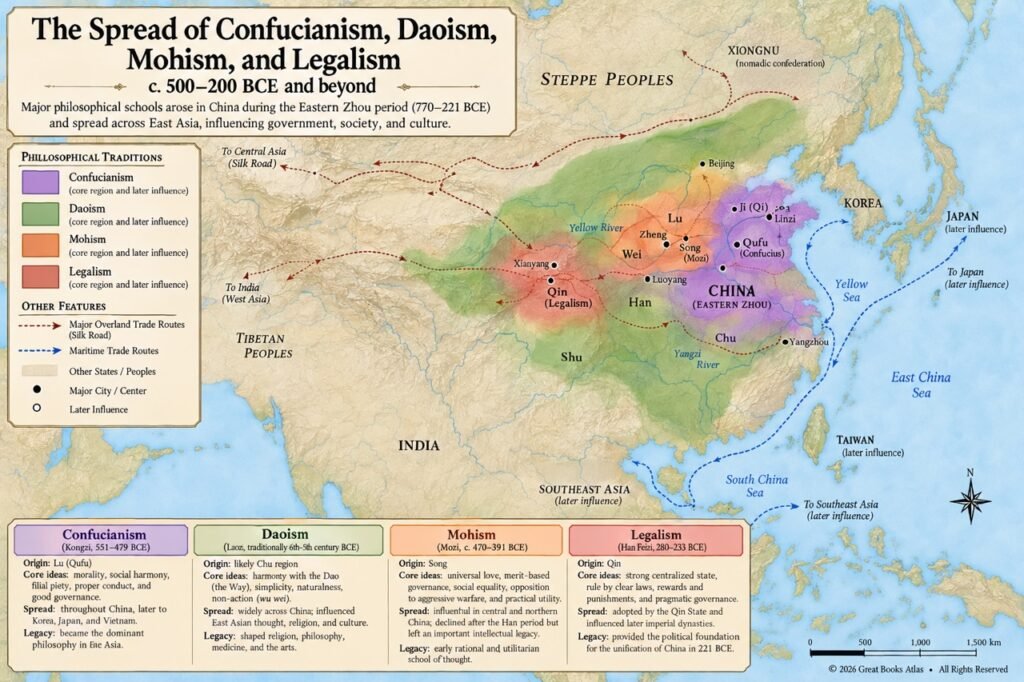
[This map was created with AI tools and is not to scale. Proportions and locations have been simplified or adjusted so all key information fits.]